
*Intelligent Machine Lab, Information Technology University, Lahore, Pakistan,
**Department of Hematology, Chughtai Lab , Lahore, Pakistan
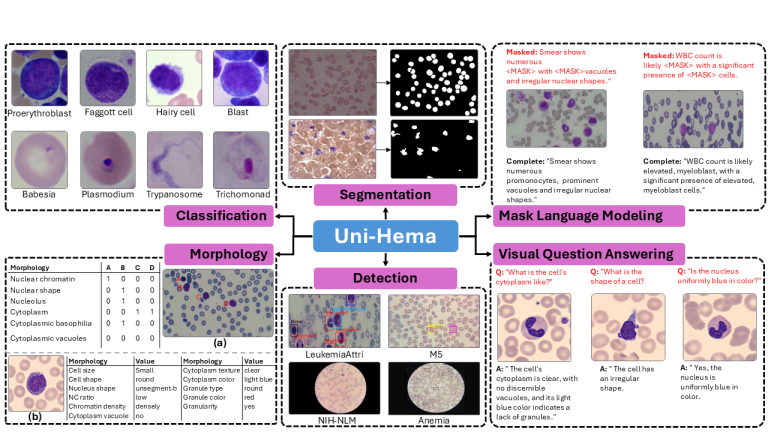
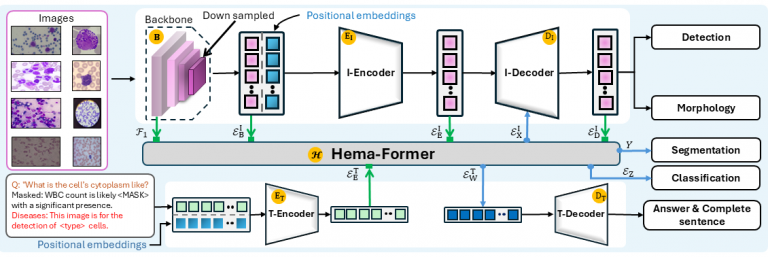
Digital hematopathology requires cell-level analysis across diverse disease categories, including malignant disorders (e.g., leukemia), infectious conditions (e.g., malaria), and non-malignant red blood cell disorders (e.g., sickle cell disease). Whether single-task, vision-language, WSI-optimized, or single-cell hematology models, these approaches share a key limitation: they cannot provide unified, multi-task, multi-modal reasoning across the complexities of digital hematopathology. To overcome these limitations, we propose Uni-Hema, a multi-task, unified model for digital hematopathology integrating detection, classification, segmentation, morphology prediction, and reasoning across multiple diseases. Uni-Hema leverages 46 publicly available datasets, encompassing over 700K images and 21K question-answer pairs, and is built upon Hema-Former, a multimodal module that bridges visual and textual representations at the hierarchy level for the different tasks (detection, classification, segmentation, morphology, mask language modeling and visual question answer) at different granularities. Extensive experiments demonstrate that Uni-Hema achieves comparable or superior performance to train on a single-task and single dataset models, across diverse hematological tasks, while providing interpretable, morphologically relevant insights at the single-cell level. Our framework establishes a new standard for multi-task and multi-modal digital hematopathology.
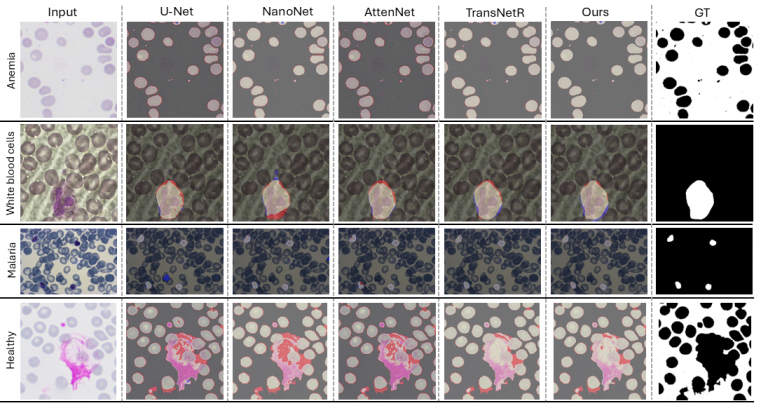
Segmentation results of TransNetR and our method on anemia, malaria, and WBC images. TP, FP, and FN are shown in light yellow, blue, and red. Our method reduces false detections and improves localization, especially for anemia and WBC, while handling malaria robustly.
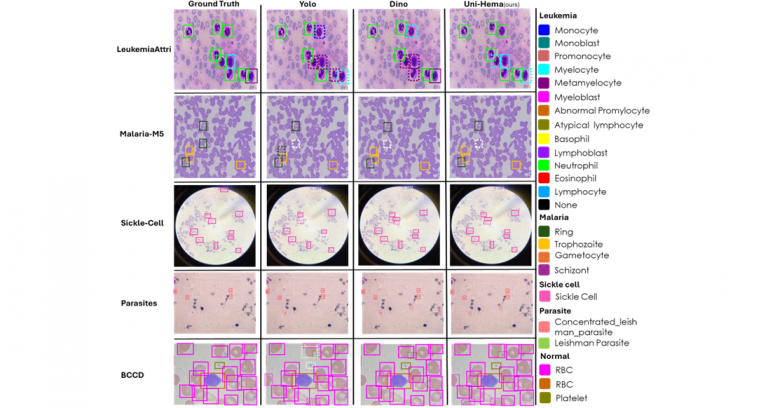
Dotted white boxes denote missed detections, while dotted colored boxes represent incorrect class predictions. Across diverse datasets, our single unified model achieves strong localization and class consistency, outperforming or matching the specialized detectors in challenging cases.
PhD Fellow
IML Lab, Department of Artificial Intelligence, ITU, Lahore, Pakistan

phdcs23002@itu.edu.pk
A Rehman
@article{rehman2025uni,
title={Uni-Hema: Unified Model for Digital Hematopathology},
author={Rehman, Abdul and Rasool, Iqra and Imran, Ayisha and Ali, Mohsen and Sultani, Waqas},
journal={arXiv preprint arXiv:2511.13889},
year={2025}
}